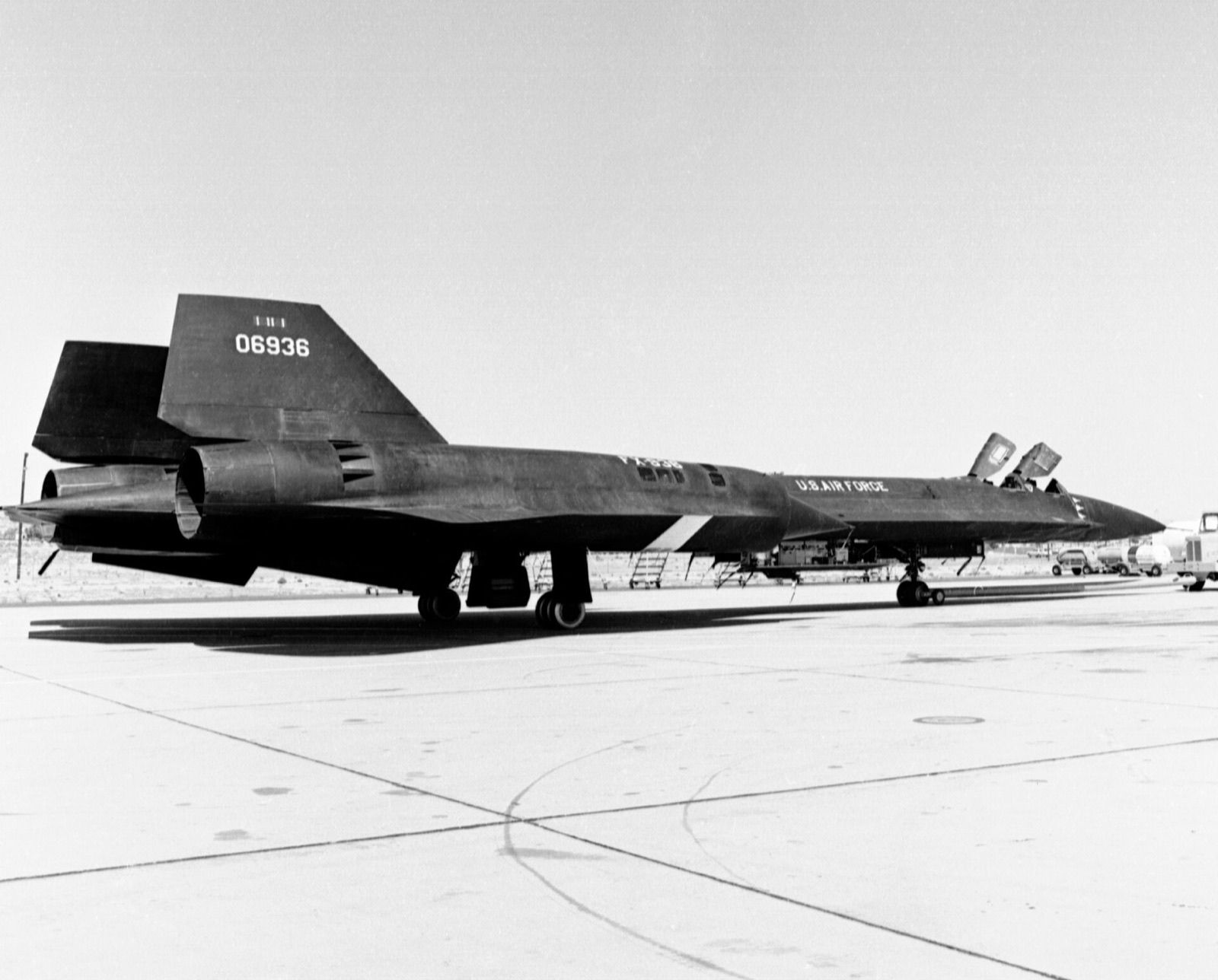
60-6936
No display location
Dots mark every surviving airframe

Record
Career
- Set world speed and altitude records on 1 May 1965: 2,070.101 mph over a straight course and 80,257.65 ft in sustained horizontal flight
- Primary USAF test aircraft in the joint NASA/USAF YF-12 programme from 1970
- Its loss led NASA to borrow SR-71A 61-7951, disguised as the 'YF-12C' with fictitious tail number 06937
How it was lost
Lost 24 June 1971 on its 62nd flight of the joint NASA/USAF programme when a fuel line in the right engine failed and caused a fire on the return to Edwards. Lt. Col. Ronald J. 'Jack' Layton and Maj. Billy A. Curtis ejected safely; the aircraft crashed near Boron, California.
In the chronology
| 1 May 1965 | YF-12A sets world speed and altitude records KEDLOCK YF-12A crews set official records including 2,070.101 mph over a 15/25 km straight course, flown by Col. Robert L. Stephens and Lt. Col. Daniel Andre, a sustained altitude of 80,257.65 feet, and closed-circuit records of about 1,643 mph (500 km) and 1,689 mph (1,000 km). Stephens and Andre received the 1965 Thompson Trophy, and these were the first of many official records for the Blackbird family. |
| 21 Sep 1966 | YF-12A's Mach 3.2 look-down missile shot KEDLOCK Flying at about Mach 3.2 and 74,000 feet, a YF-12A fired an AIM-47 at a QB-47 target drone flying near sea level, the best known of the interceptor's test shots. In all, seven guided AIM-47 launches from YF-12As scored six kills, the one miss being blamed on a missile power failure. |
| 29 Dec 1967 | F-12B interceptor cancelled KEDLOCK Defense Secretary Robert McNamara would not fund the operational F-12B interceptor, and on 29 December 1967 the Air Force instructed Lockheed to stop F-12B development; the YF-12A program ended on 1 February 1968 and the surviving YF-12As went into storage. NMUSAF cites high costs, the Vietnam War and a lower priority for continental air defense. |
| 18 Jul 1969 | NASA and USAF announce joint YF-12 research program NASA NASA and the Air Force announced a joint flight research program using YF-12As 60-6935 and 60-6936 taken from Air Force storage. NASA's work focused on loads, structural heating, propulsion and supersonic cruise technology, led by Gene Matranga. |
| 24 Jun 1971 | YF-12A 60-6936 lost to in-flight fire NASA On its 62nd flight of the joint program, a failed fuel line in the right engine started a fire; Lt. Col. Ronald 'Jack' Layton and Maj. Billy Curtis ejected uninjured near Edwards AFB. It was the YF-12 research program's only crash. |
Where the record disagrees
First flight (13 Mar 1964, pilot Robert Gilliland) and total hours (439.8) come from secondary sources only. Wikipedia's YF-12 page gives the loss date as both 24 June and 24 July 1971; the NASA flight log and mishap report confirm 24 June 1971. Record crew is usually given as Col. Robert L. 'Fox' Stephens and Lt. Col. Daniel Andre (some sites say David). Record figures vary slightly between sources (altitude 80,257.65 ft per NASA and CIA; 80,257.86 or 80,259 ft elsewhere). NASA's 'YF-12C' was not a YF-12: see SR-71A 61-7951.
Sources
- NASA. Mach 3+: NASA/USAF YF-12 Flight Research, 1969-1979 (Peter W. Merlin, NASA SP-2002-4525). Open · Archived · In the register
- This Day in Aviation. Tag Archives: 60-6934 (YF-12A first flight, 1966 accident, 1965 records by 60-6936). Open · Archived · In the register
- Wikipedia. Lockheed YF-12. Open · Archived · In the register
- Photorecon.net. YF-12A 60-6936 (Article 1003) profile. Open · Archived · In the register